
Towing Basics
Match your vehicle to your RV
Before you fall in love with a floor plan, start with the numbers. Your tow vehicle has limits set by the manufacturer, and your RV has weights that change the moment you load gear, water, and passengers. Towing safely means understanding how those numbers line up.
The two that matter most are dry weight (what the RV weighs empty from the factory) and GVWR (the maximum the RV is rated to weigh fully loaded). The gap between them is the cargo you can safely add. Just as important is tongue weight — the downward force the trailer places on your hitch — and your truck's payload, which that tongue weight eats into.
Our rule of thumb: stay at or below 80% of your tow vehicle's maximum rating. That cushion gives you safer braking, better stability in crosswinds, and a far more relaxed drive through the North Georgia mountains.
- Know your dry weight & GVWR
- Account for tongue weight
- Don't forget payload
- Follow the 80% rule
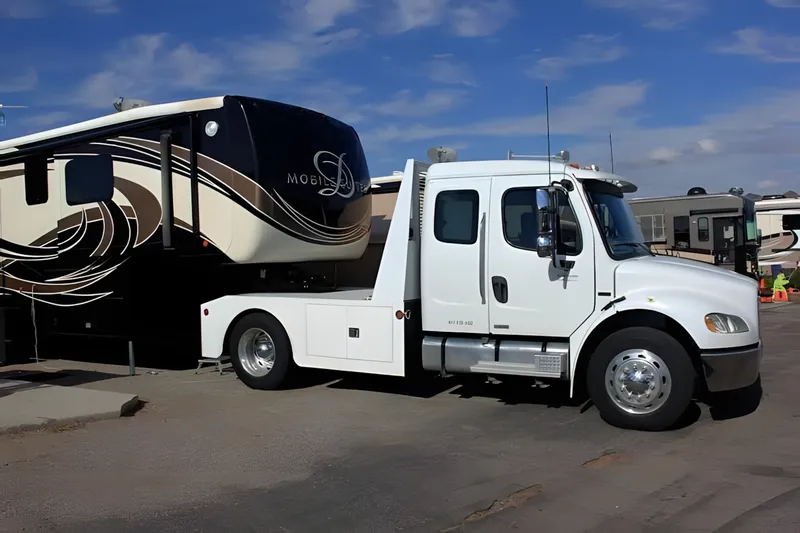
The Numbers
Towing terms explained
A quick plain-English glossary of the weight ratings you'll see on spec sheets and door jamb stickers.
Dry Weight
The weight of the RV as it leaves the factory — no water, propane, cargo, or passengers. It's a starting point, not your real-world towing weight.
GVWR
Gross Vehicle Weight Rating — the maximum the RV can safely weigh fully loaded. Never exceed it, and make sure your tow vehicle can handle it.
Tongue / Hitch Weight
The downward force the loaded trailer puts on your hitch — typically 10–15% of the trailer's total weight. Too little causes sway; too much overloads your rear axle.
Payload Capacity
How much weight your tow vehicle can carry inside it — passengers, gear, and the trailer's tongue weight all count against this number.
Cargo Carrying Capacity
The difference between the RV's dry weight and its GVWR — the real amount of water, propane, and gear you can load before you're over the limit.
The 80% Rule
Stay at or below 80% of your tow vehicle's maximum tow rating. That built-in margin means safer stops, steadier handling, and a longer-lasting drivetrain.
Quick Reference
Typical tow weights by RV type
Use these ranges as a starting point. Always confirm the exact weights for the specific RV and the tow rating for your vehicle.
| RV Type | Typical Dry Weight | Recommended Tow Vehicle |
|---|---|---|
| Teardrop / Small Trailer | 1,000–3,500 lb | Midsize SUV or truck |
| Lightweight Travel Trailer | 3,500–5,000 lb | Full-size SUV |
| Travel Trailer | 5,000–7,500 lb | Half-ton pickup |
| Fifth Wheel | 7,500–12,000 lb | 3/4-ton pickup |
| Toy Hauler | 7,000–11,000 lb | 3/4-ton pickup |
| Destination Trailer | 9,000–13,000 lb | Delivered — not frequently towed |
Before You Roll
Pre-trip towing checklist
Run through these every time you hitch up. Two minutes here prevents the vast majority of towing problems on the road.
- Hitch secured & pinned
- Safety chains crossed under the coupler
- Breakaway cable connected
- Trailer brakes tested
- Lights & turn signals working
- Tires aired to spec
- Weight distribution set
- Mirrors adjusted for the trailer
Not sure what your truck can tow?
Tell us your tow vehicle and how you like to camp — our team will match you to the right RV and make sure the numbers add up before you ever hit the road.